
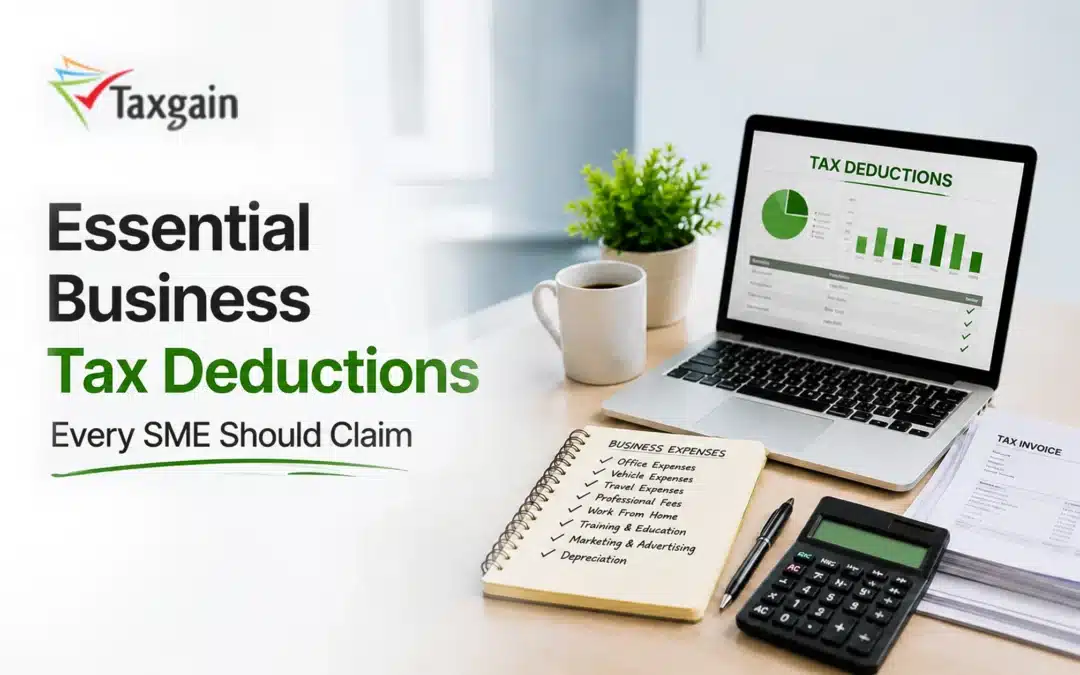
Operating an SME in Australia requires careful control of costs, such as payroll, rent, subscriptions, and supplier payments, all of which impact profit margins. Understanding SME tax deductions helps reduce taxable income and improve overall cash flow.
At Taxgain, we assist business owners in identifying the full range of small business tax deductions available to them. The ATO 2026 report notes that many SMEs under-claim allowable expenses or fail to maintain adequate records. When properly managed, these deductions deliver meaningful small business tax benefits and support stronger financial performance.
Understanding SME Tax Deductions
SME tax deductions are allowable business expenses incurred in the course of generating assessable income. These deductions reduce taxable income, meaning the business is taxed on net profit rather than gross revenue.
Under the Australian Taxation Office (ATO) guidelines, expenses must be business-related, not private in nature, and properly substantiated with supporting documentation. Proper record-keeping ensures compliance and protects the deductibility of legitimate claims.
Essential SME Tax Deductions for Small Businesses
Below are some of the most common and valuable essential business tax deductions that SMEs should consider.
1. Operating Expenses
Operating costs form the foundation of most SME tax deductions. These are recurring expenses required to maintain daily business operations.
Common deductible items include:
- Office or commercial rent
- Electricity, internet, and telephone expenses (business portion only)
- Office supplies and consumables
- Software and digital subscription services
Where costs are used for both private and business purposes, only the business-use portion is deductible under ATO rules.
2. Employee Salary Deductions
Employee salary deductions represent one of the largest expense categories for SMEs. These deductions contribute significantly to overall small business tax benefits.
Employee salary deductions may include:
- Salaries and wages
- Superannuation contributions (deductible only when paid)
- Bonuses and commissions
- Contractor payments (where correctly classified)
It’s important to ensure superannuation is paid on time to remain deductible in the same financial year. Proper payroll compliance supports accurate SME tax deductions and avoids unnecessary penalties.
3. Travel Expenses Deductions
Travel expenses deductions are available when travel is directly connected to business activities.
Allowable expenses include:
- Business-related airfares and accommodation
- Taxi, rideshare, and public transport costs
- Parking fees and tolls
For vehicle use, SMEs must apply either the ATO logbook method or the cents-per-kilometre method, depending on eligibility. Travel between home and a regular place of work is generally not deductible under ATO rules.
4. Equipment and Asset Depreciation
Purchasing equipment is often necessary to operate efficiently. These costs may be claimed either immediately (where eligible) or gradually through depreciation.
Common deductible assets include:
- Computers and laptops
- Tools and machinery
- Office furniture
- Business equipment
Depending on current ATO thresholds, some items may qualify for an instant asset write-off. Otherwise, the deduction is spread across the asset’s effective life.
5. Marketing Expenses Deduction
A marketing expenses deduction is fully allowable when expenses are incurred for promoting and growing business revenue.
Marketing expense deductions may apply to the following:
- Website design, hosting, and maintenance
- Digital advertising campaigns
- Social media marketing services
- Branding and promotional materials
These costs are directly linked to income generation and are often underclaimed by small businesses.
6. Home Office Tax Deductions
With increasing remote work arrangements, home office tax deductions have become highly relevant for SMEs.
Eligible claims may include:
- A portion of electricity and internet costs
- Depreciation on office furniture and equipment
- Business phone usage
- Office consumables used at home
These deductions must be calculated using ATO-approved methods such as the fixed-rate method or actual-cost method. Proper apportionment between business and private use is required.
7. Tax Deductions For Startups
New businesses are also entitled to a range of tax deductions for startups.
These may include:
- Business registration and licensing fees
- Legal and accounting advice
- Initial marketing costs
- Set-up and establishment expenses
Claiming these correctly from the beginning can provide valuable small business tax benefits during the early growth phase.
Common Mistakes SMEs Should Avoid
While claiming deductions is important, ensuring they are correctly substantiated is equally crucial. Some common errors include:
- Treating personal expenses as business deductions
- Inadequate or missing documentation
- Overlooking depreciation on business assets
- Ignoring small, recurring costs that add up
- Not reviewing available small business tax deductions regularly
Good record-keeping and professional oversight make a significant difference in avoiding these pitfalls.
Why Professional Tax Advice Makes a Difference
The knowledge of ATO regulations and keeping up with any changes is an ongoing process. Opportunities to get tax deductions come and go, and to maximise them, you have to plan properly as part of your overall business plan.
At Taxgain, we assist business owners to know which deductions are relevant to their case and ensure claims are compliant with the ATO and adequately supported by documentation. With the help of knowledgeable accountants, it may be easier to handle tax time, as well as to make sure you are not leaving valuable deductions unclaimed.
Conclusion
Identifying and claiming the right SME tax deductions can make a real difference to your business finances. Home office tax deductions and home office travel expense deductions, among other employee salary deductions and travel expense deductions, are all eligible claims that help in lowering taxable income and enhancing cash flow.
To check whether you are claiming all the deductions available, you may wish to have your records reviewed with a professional to help you comply with the requirements of the ATO and maximise your entitlement.
In Taxgain, we assist the SMEs in remaining accurate, compliant and tax-efficient during the year.
Contact Taxgain to ensure that your business is not losing out on good tax deductions.